
Guide to Annual General Meetings in Singapore 2026
10 minutes read | Published on 10 Aug 2026
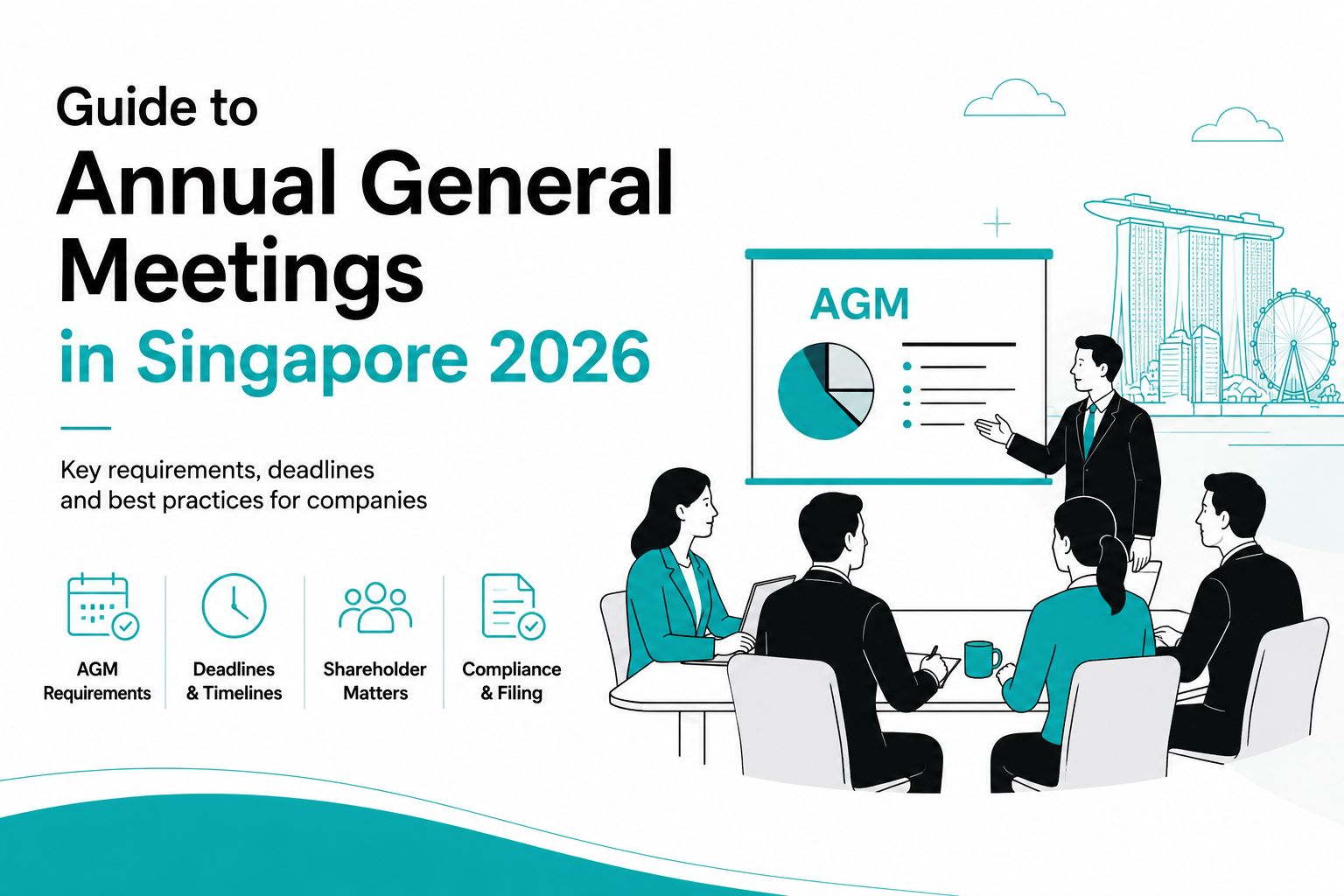
For Singapore companies, compliance does not end with bookkeeping and tax filing. One of the key statutory obligations under the Companies Act is the Annual General Meeting (AGM). Whether you are a startup founder, SME owner, or director of an established company, understanding AGM requirements is essential to maintaining good corporate governance and avoiding penalties.
In this guide, we explain what an AGM is, who needs to hold one, when it must be conducted, and how it relates to your Annual Returns filing obligations.
What is an Annual General Meeting?
An Annual General Meeting (AGM) is a statutory meeting where a company’s directors present its financial performance and key business matters to shareholders, allowing them to review, discuss, and approve important corporate decisions.
Do you need to hold an AGM before filing your Annual Returns?
Before submitting your Annual Returns to ACRA, your company may be required to hold an Annual General Meeting (AGM). However, depending on the company's circumstances, an AGM may be held, dispensed with, or exempted under the Companies Act.
What happens during the AGM?
1. Presenting and adopting financial statements
One of the primary purposes of an AGM is to present the company's financial statements to its shareholders. These financial statements provide a comprehensive overview of the company's financial position and performance during the financial year. Shareholders are given the opportunity to review the accounts, ask questions, and formally approve the financial statements.
For private companies, financial statements must be presented to shareholders within 6 months after the company's financial year end (FYE).
2. Approving key corporate matters
In addition to reviewing the company's financial performance, the AGM serves as a platform for shareholders to consider and approve important corporate decisions. These resolutions help ensure that shareholders remain involved in the governance and strategic direction of the company.
Common matters that are typically tabled for shareholder approval at an AGM include:
Declaration and approval of dividends
Appointment, re-appointment, or retirement of directors
Appointment or re-appointment of auditors (if applicable)
Approval to issue new shares or allot additional shares
Other ordinary or special resolutions affecting the company's operations and governance
By voting on these matters, shareholders play an active role in overseeing the company's management and safeguarding their interests.
Who must hold an AGM?
All Singapore companies are required to hold AGMs unless they have met the exemption requirements or have formally dispensed with the requirement.
When are private companies exempt from holding an AGM in Singapore?
Exemptions from Holding an AGM
Private companies can skip holding an AGM if they meet any of the following requirements to be exempted:
The company's financial statements are circulated to all shareholders within five months after the FYE, and no shareholder requests an AGM; or
The company is a dormant private company (or not a subsidiary of a listed company) and has total assets of S$500,000 or less (consolidated value if it is an ultimate parent company).
Dispensing with AGMs Permanently
Private companies may also choose to permanently dispense with AGMs by passing a written resolution. Under this arrangement, matters that would ordinarily be discussed and approved at an AGM can instead be resolved through written resolutions.
However, shareholders retain the right to request an AGM in the future. If a valid request is made, the company must arrange for the meeting to be held.
Situations where an AGM must still be held
Even if your company qualifies for an AGM exemption, an AGM may still be required under the following circumstances:
If a shareholder requests an AGM at least 14 days before the end of the sixth month after the FYE, the company must convene the meeting within that six-month period.
If a shareholder or the company's auditor requests an AGM after receiving the financial statements, the meeting must be held within 14 days from the date of the request.
For dormant companies that are exempt from preparing financial statements, an AGM is generally not required unless a shareholder specifically requests one.
When must a company hold an AGM in Singapore?
The due dates for holding an AGM is as follows:
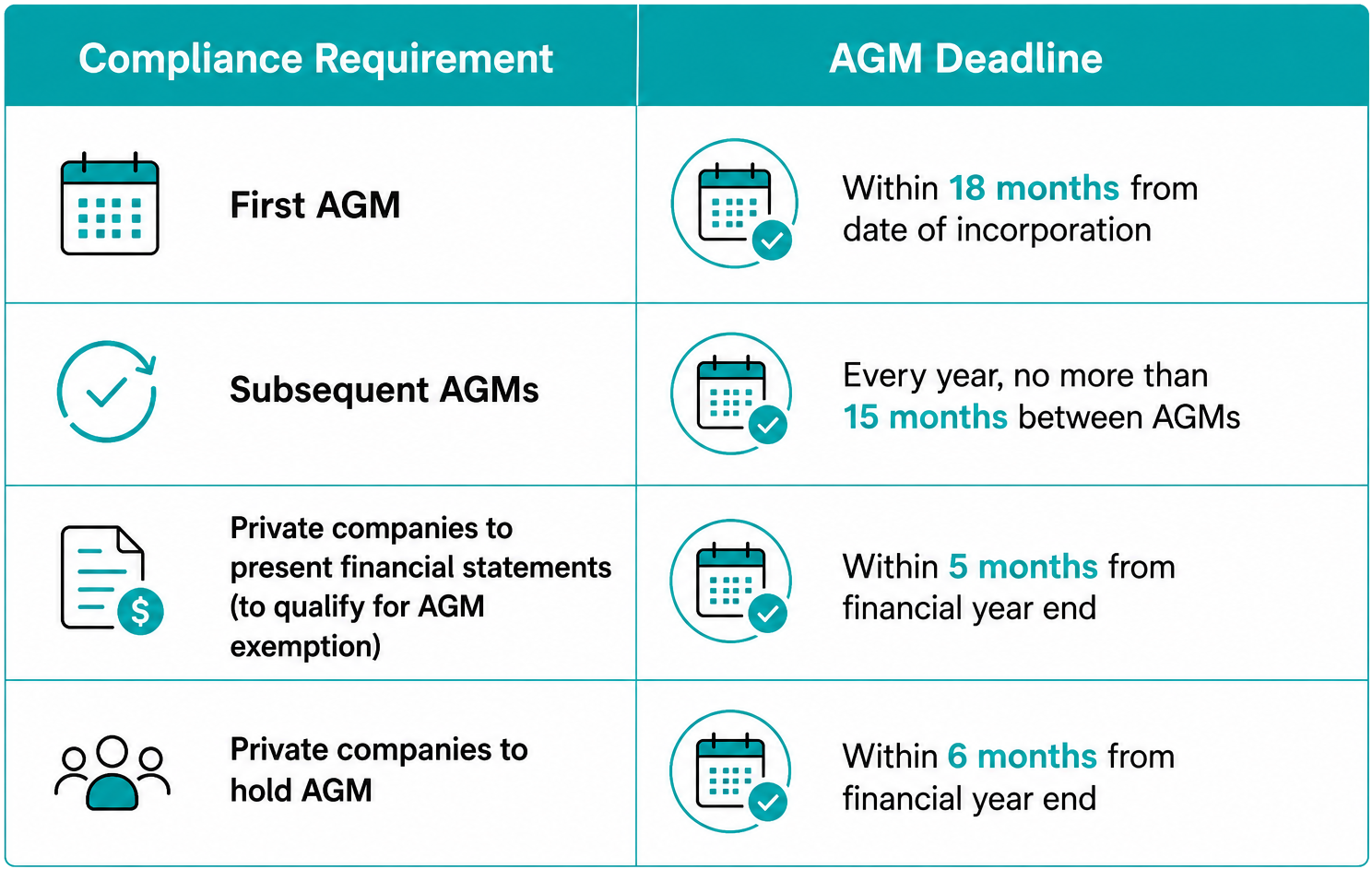
For example, if a private company has a financial year end of 31 December 2025, it must hold its AGM by 30 June 2026 unless it qualifies for an exemption or has dispensed with AGMs.
What happens if you miss the AGM deadline?
Failure to comply with AGM requirements may result in enforcement action by ACRA.
Directors who fail to hold AGMs within the prescribed timelines may face penalties, composition fines, prosecution, disqualification, or debarment from holding directorship positions in Singapore companies. Repeated non-compliance can also negatively impact a company's compliance record.
If a company anticipates difficulty meeting its AGM deadline, it may apply to ACRA for an Extension of Time (EOT) before the due date.
How Ledgify can help
Managing AGM obligations can be challenging, especially for busy entrepreneurs and growing businesses. While many private companies today qualify for AGM exemptions or dispensation, directors must still understand their obligations and ensure that shareholders' rights are protected.
As a corporate service provider registered with ACRA, Ledgify helps Singapore companies stay compliant with their statutory requirements.
Our corporate secretarial team can assist with:
Assessing your AGM obligations
Preparing AGM resolutions and documentation
Advising on AGM exemptions and dispensation
Maintaining statutory records
Filing Annual Returns with ACRA accurately and on time
By partnering with Ledgify, you can focus on growing your business while ensuring your company remains compliant with Singapore's corporate regulations.
