
Guide to XBRL Filing in Singapore 2026
10 minutes read | Published on 10 Aug 2026
If your company is incorporated in Singapore, there's a good chance you'll need to file your financial statements in XBRL format as part of your Annual Return submission to the Accounting and Corporate Regulatory Authority (ACRA). While many business owners are familiar with Annual Returns, XBRL filing remains one of the most misunderstood compliance requirements.
This 2026 guide explains what XBRL filing is, who needs to file, the different XBRL formats available, and how to complete your XBRL filing accurately and on time.
What is XBRL?
XBRL stands for eXtensible Business Reporting Language, a reporting format used for the electronic submission of financial statements. Instead of submitting financial data as plain text or PDF, XBRL uses predefined tags that standardises financial reporting, allowing regulators and stakeholders to analyse financial information efficiently.
Who needs to file XBRL in Singapore?
All Singapore-incorporated companies must prepare financial statements in XBRL format, except for dormant relevant companies or companies that qualify for exemption. The financial statements prepared in XBRL format are submitted to ACRA as part of the Annual Returns filing.
The type and extent of filing depends on the company’s nature and size of operations. Certain regulated entities, such as those in the banking, finance and insurance industries, use sector-specific XBRL templates.
Most private companies will file either in simplified or full XBRL format.
Filing financial statements in simplified XBRL format
Small and non-publicly accountable companies, including insolvent EPCs that cannot pay their debts as and when they are due, qualify to file their financial statements using the simplified XBRL format, together with a PDF copy of their financial statements authorised by their directors.
What is a ‘small company’?
A small company is one where both conditions are met:
Revenue for the current financial year does not exceed S$500,000; and
Total assets for the current financial year do not exceed S$500,000.
What is a non-publicly accountable company?
Your company is a non-publicly accountable company if it is:
Not a listed company
Not a banking and payment system entity
Not an insurance entity
Not a capital market infrastructure provider
Not a capital markets intermediary
Not any other regulated entity
Filing financial statements in full XBRL format
Companies that do not qualify for simplified XBRL are generally required to file their financial statements using the full XBRL format, together with a PDF copy of their financial statements authorised by their directors. These filings contain a more comprehensive set of financial disclosures.
How to prepare XBRL financial statements
There are three ways to prepare your company’s financial statements in XBRL format and file them as part of the Annual Returns filing with ACRA.
1. Use ACRA's BizFinx preparation tool
BizFinx is ACRA's free software that allows companies to prepare and validate XBRL financial statements before submission. The tool supports the latest ACRA Taxonomy 2026 requirements.
2. Use an approved accounting software
Some accounting software offer integrated XBRL preparation and filing capabilities, which can reduce manual data entry and improve efficiency.
3. Engage a Corporate Service Provider (CSP)
Many SMEs engage professional corporate secretarial or accounting firms to prepare and file XBRL financial statements on their behalf. This is often the preferred option for companies with more complex financial reporting requirements.
What are some of the common XBRL filing mistakes?
XBRL filing can be technical, particularly for companies preparing filings internally for the first time.
Some of the common issues include:
1. Incorrect mapping of financial statement items
Every line item in your financial statements must be mapped correctly to the relevant ACRA taxonomy element. Incorrect mapping can lead to validation errors or inaccurate disclosures.
2. Mismatched figures
Differences between the PDF financial statements and XBRL data can trigger validation issues and filing delays.
3. Incomplete disclosures
Required disclosures may be omitted when companies are unfamiliar with the applicable XBRL template.
4. Using outdated software versions
ACRA introduced updated filing tools and taxonomy requirements in February 2026. Companies should ensure they are using the latest versions of BizFinx and related filing tools.
Who does not need to file XBRL?
Dormant relevant companies
In order to be regarded as a dormant relevant company, all of the following requirements must be met:
The total assets of the company (or consolidated total assets company of the group, if the company is a parent company) during the financial year did not exceed S$500,000;
Your company has been dormant from either the time of formation or from the end of the previous financial year; and
Your company is not a listed company or a subsidiary of a listed company.
Solvent Exempt Private Companies
A solvent Exempt Private Company (EPC) is generally not required to file its financial statements with ACRA. Instead, an online declaration of solvency is made when filing the company’s Annual Returns.
Your company may be regarded as a solvent EPC if both of the conditions below are met:
If your company is a private company with less than 20 shareholders and no corporation holds direct/ indirect beneficial interest in your company’s shares (or if your company is a private company owned by the Government and declared as an EPC by Gazette); and
Your company is solvent and can meet its debts as and when they are due.
However, if a solvent EPC chooses to file its financial statements voluntarily, it must comply with ACRA’s XBRL filing requirements.
Companies exempt from XBRL filing requirements
Certain entities are exempt from XBRL filing requirements and may only need to submit financial statements in PDF format. These include:
Companies limited by guarantee
Companies granted approval by ACRA to use alternative accounting standards.
Eligibility should always be reviewed carefully before filing.
Companies in regulated industries
Companies that are in the banking, finance or insurance industries that are regulated by the Monetary Authority of Singapore (MAS) use sector-specific XBRL templates.
Important things to know about XBRL filing deadlines in Singapore
Understanding XBRL filing deadlines is essential for maintaining compliance with ACRA. Since XBRL financial statements are typically submitted together with the company's Annual Return, missing the filing deadline can result in late filing penalties and enforcement actions.
1. XBRL filing deadlines are tied to your Financial Year End (FYE)
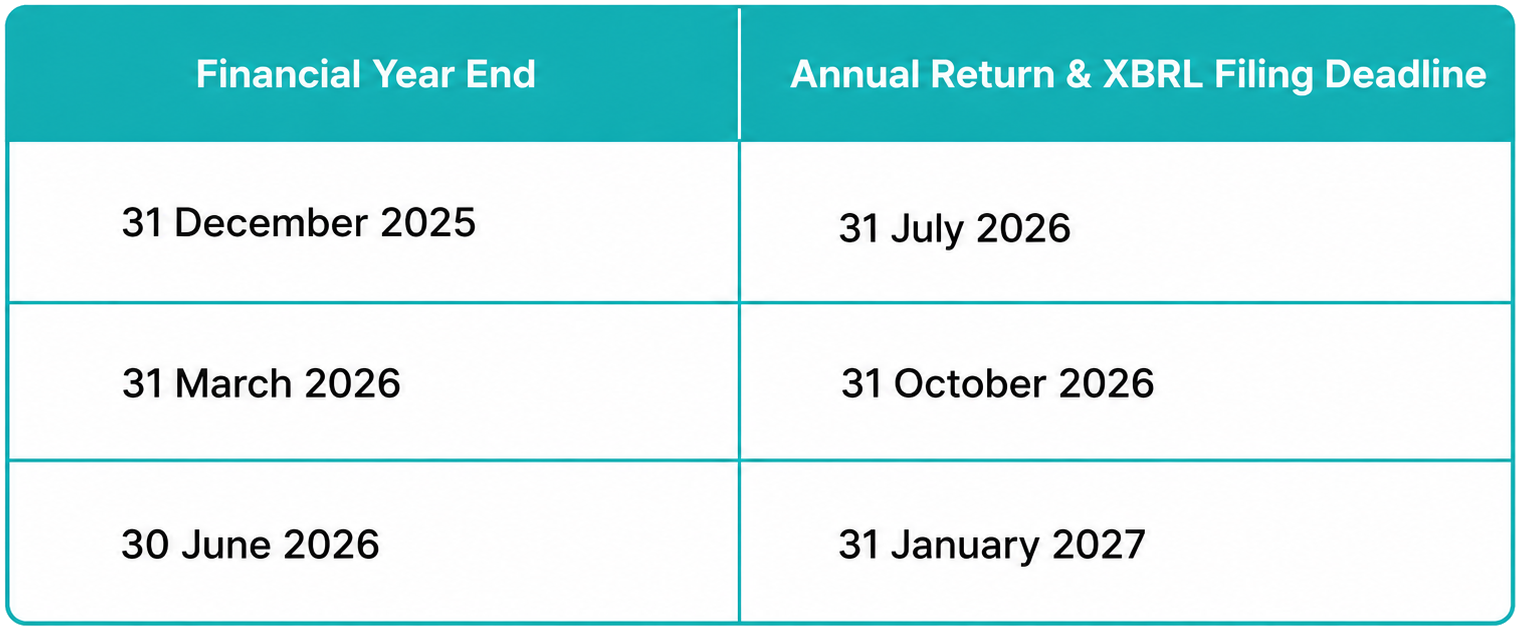
Unlike tax filing deadlines that are based on a fixed calendar date, XBRL filing deadlines depend on your company's Financial Year End (FYE). Most private limited companies in Singapore must file their Annual Return, together with any required XBRL financial statements, within seven months after their FYE.
For example:
2. Late filing penalties can be costly
ACRA imposes late lodgement penalties on companies that fail to file their Annual Returns on time. Penalties can reach up to S$600, and directors may face enforcement action for persistent non-compliance.
In addition to monetary penalties, late filings may:
Affect the company's compliance record
Create difficulties when applying for financing or grants
Delay corporate transactions such as fundraising or shareholder transfers
Increase the risk of regulatory scrutiny
Important XBRL filing tips
1. Maintain accurate accounting records
Good bookkeeping is critical for successful XBRL filing. Since XBRL requires financial data to be tagged and mapped according to ACRA's taxonomy, poor record-keeping can significantly increase filing complexity.
2. Understand whether simplified XBRL applies
Most startups and SMEs that are non-publicly accountable will typically qualify to file using the Simplified XBRL format, which requires fewer disclosure elements than Full XBRL. However, eligibility should be assessed carefully based on the company's circumstances and ACRA's requirements.
3. Consider engaging a professional service provider
Many Singapore companies choose to outsource their XBRL filing to a corporate secretarial or accounting firm. This can help business owners focus on growing the business while ensuring compliance with ACRA's filing requirements.
Professional assistance is particularly valuable if:
You are unfamiliar with Singapore corporate compliance requirements
Your company has multiple shareholders
You expect rapid business growth
You require Full XBRL filing
4. Build a compliance calendar early
XBRL preparation often takes longer than expected and many businesses underestimate the time required to prepare XBRL financial statements. Common delays include:
Incomplete bookkeeping records
Incorrect mapping of financial statement items
Validation errors within the XBRL file
Missing supporting disclosures
A best practice adopted by many SMEs is to begin preparing XBRL filings at least one to two months before the Annual Return deadline. This provides adequate time to resolve validation errors and obtain any necessary approvals before filing.
In addition, creating a compliance calendar can help ensure timely completion of:
Annual Return filings
Corporate tax filings
Director and shareholder updates
Other ACRA compliance obligations
Whether you are filing Simplified XBRL or Full XBRL, early preparation and a clear understanding of the rules will help keep your company compliant throughout the year. By establishing good compliance habits, your company can avoid penalties and maintain a strong corporate governance record as your business grows.
How Ledgify can help with XBRL filing in Singapore
For many SMEs, engaging an experienced corporate services provider can significantly reduce the administrative burden and ensure compliance with ACRA's latest requirements.
Ledgify is a Corporate Service Provider (CSP) registered with ACRA and provides professional XBRL filing services for Singapore companies, helping businesses meet their ACRA compliance obligations accurately and on time.
From preparing and validating XBRL financial statements to handling the final submission, our experts manage the entire process for you.
Need Help with XBRL Filing?
Contact Ledgify today to learn how we can simplify your XBRL filing requirements and keep your business compliant.
